First-trimester ultrasound screening
A second pair of eyes for the first-trimester ultrasound.
IAMedic analyses the ultrasound video in real time: it recognises the mid-sagittal plane, locates the nuchal translucency and the nasal bone, and measures the NT. The clinical decision stays with the professional.
Tested live with a real ultrasound machine
01 — The challenge
The best plane lasts an instant. The measurement leaves no room for error.
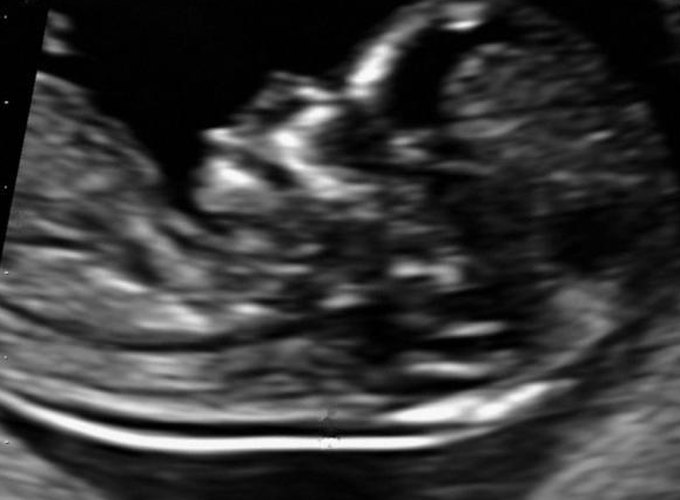
First-trimester screening (11 to 13+6 weeks) combines nuchal translucency (NT) and the nasal bone (NB) to estimate the risk of chromosomal anomalies. Both are assessed on a perfect mid-sagittal view that has to be found and frozen while the fetus moves.
- 70–80 % of trisomy 21 cases are identified with maternal age and NT, with about 5 % false positives.
- 95 %+ detection when serum biochemistry and the nasal bone are added.
- 60–70 % of fetuses with trisomy 21 show no nasal bone, versus about 2 % of chromosomally normal ones.
- ~7× less variability between operators when NT is measured with a semi-automated method (standard deviation from 0.109 to 0.0149 mm).
Sources: Nicolaides, The 11–13 weeks scan (FMF, 2004); Cicero et al., The Lancet, 2001; Moratalla et al., Ultrasound Obstet Gynecol, 2010.
02 — Product
From the ultrasound signal to the measurement, in one flow.
-
Full system
Real-time video
Connect the ultrasound machine through a video capture card and watch how useful the current frame is, live: a compass to find the mid-sagittal plane.
-
Full system
Automatic frame selection
It saves useful frames on its own so you can review them later. On recorded videos, the criteria are adjustable.
-
Full system
NT and nasal bone localisation
It marks the NT and the NB on the frozen frame. The NB is defined together with the nasal skin and tip, as the FMF guidelines indicate.
-
New
Automatic NT measurement
It computes the NT thickness in millimetres. The endpoints can be corrected by hand.
-
Full system
Review and annotation
The professional moves, corrects or discards each box, crops the region of interest and decides. It accepts images, video and DICOM, with automatic anonymisation.
-
Full system
Data platform
Studies, annotations and statistics in one place.
03 — How it works
A study as usual, with help where it is needed most.
-
01
Connect the machine
A video capture card links the machine's HDMI output to the computer. Designed for ultrasound machines already installed, from any manufacturer.
-
02
Run the study
The app processes the video without interrupting you and shows live how good the fetal position is.
-
03
Review the frames
Useful frames are saved automatically for later analysis, even those the eye can miss.
-
04
Locate and measure
On the frozen frame the NT and the NB are located, and the NT is measured.
-
05
Decide
The professional validates, corrects and saves. IAMedic assists: it never diagnoses.
04 — What's new
Automatic nuchal translucency measurement.
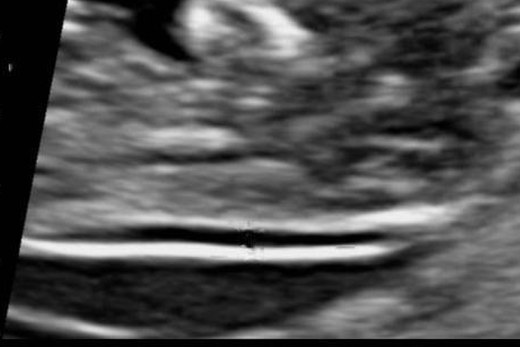
Besides locating the NT, the demo segments and measures it. It is a research prototype to explore assisted measurement.
- It segments the NT and computes its thickness automatically.
- Thickness is reported in millimetres, calibrated with the pixel size.
- The endpoints can be dragged to correct the measurement.
Research prototype, not clinically validated yet: the measurement that counts is the professional's.
 NT
05 — Results
Numbers from the real-time system.
Accuracy, mAP and IoU measured on real studies.
-
83%
Accuracy when classifying useful frames
Target: above 70 %.
-
0.77
mAP@50 of the NT and NB detector
-
0.66
Mean IoU of the boxes
Target: above 60 %.
-
22.5ms
Mean classification latency
Maximum: 80.2 ms.
Evaluated at a single centre: multicentre validation is still pending.
06 — Trust
Built for clinical data from day one.
-
Secure access
Secure sign-in, and every doctor is approved by an administrator.
-
Encrypted traffic
All communication is encrypted.
-
Anonymised data
Personal data is removed from DICOM files on upload.
-
Ethics and consent
Protocol approved by the Research Ethics Committee of Hospital Materno Infantil Ramón Sardá, and consent from every patient.
It follows security and privacy good practices for medical software (references: HIPAA, GDPR and ANMAT). It does not have formal certification yet.
07 — Team
Engineering and medicine, with one goal.
-

Bioeng. Gonzalo Grau
CEO
-

Bioeng. Josué Laszeski
CTO
-

Franco Rabaiotti
COO
-

Tomas Gonzalez
ML/AI developer
With the collaboration of Centro Médico Solimed.
08 — Frequently asked questions
What you need to know.
Does IAMedic replace the doctor?
No. It is a support tool: interpretation and diagnosis always belong to the professional.
Is it compatible with my ultrasound machine?
It works with the video signal through a capture card, so it is designed for ultrasound machines already in place, from any manufacturer. Videos, images and DICOM files can also be uploaded.
What do I need to get started?
A computer with a browser, a video capture card and an ultrasound machine with a video output, such as HDMI.
Does it measure the nuchal translucency?
The demo does: it segments the NT and computes its thickness. It is a research prototype. The real-time system locates the NT and the nasal bone; measurement is still in development.
Is it clinically validated?
It was evaluated with real data and a live test, but with a single centre and operator. It is not a certified medical device and does not replace a clinical study.
How is patient data protected?
Encryption in transit, role-based access and anonymisation of DICOM files.
Let's talk.
We believe cutting-edge technology, applied directly to medicine, can transform patients' quality of life.